


Application Modernisation | Not as Black and White as it seems
By Arrk Team |
|
4 mins read |

You’ve established your legacy system isn’t meeting your constantly evolving needs, but the thought of scrapping it and starting afresh is waking you up in the middle of the night. Surely there must be a way to modernise? But how much time and resource is it worth investing to reduce your technical debt? And how far do you go before you finally admit defeat?
At least you can feel safe in the knowledge that you’re not alone in battling this conundrum. According to MIT, 67% of C-level executives would like to completely replace their core legacy systems, but at the same time, 70% say they’d like to keep their systems as long as possible. To replace, or not to replace? That is the question.
Choosing how far you modernise doesn’t have to be a black or white solution though; it should encourage a whole spectrum of different methods and processes to be explored. From re-hosting and re-factoring through to a complete re-build – application modernisation is what you make of it.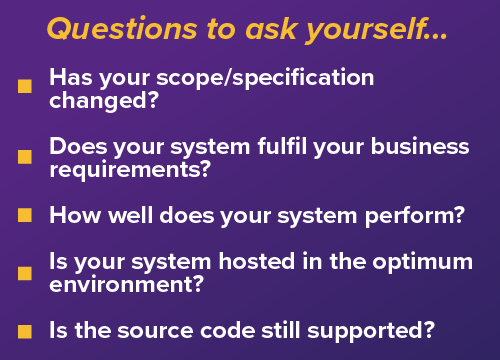
Before deciding which route to go down, you need to ask yourself some important questions about why you’re having to modernise your application. Has the scope or specification of your application changed? Does it still fulfil your business requirements? How well is your system performing or is the source code still supported? By answering these questions you’ll be on the way to finding the right solution.
With multiple options available (and often combined), choosing the right approach can feel like navigating a minefield. Here’s a quick guide:

Encapsulate
Your system performs well and meets most business requirements, but you want to extend its scope. Encapsulation allows you to leverage and extend features by wrapping existing data and functions.

Re-host
If your application meets requirements but runs in a sub-optimal environment, re-hosting moves it to a new physical, virtual, or cloud infrastructure, without altering code or features.

Re-platform
Performance concerns? Re-platforming involves minimal code changes to adapt to a new runtime platform, improving efficiency without altering core functionality.

Re-factor
When performance issues coincide with changing business needs, re-factoring restructures and optimises existing code without changing external behaviour.

Re-architect
If your system isn’t delivering as expected, re-architecting materially alters the code to shift to a new architecture, unlocking advanced platform capabilities.

Re-build
Using outdated or unsupported code? Re-building from scratch while preserving scope and specifications reduces risk and improves maintainability.

Replace
If none of the above solves your issue, replacement may be the only option. Though drastic, it ensures alignment with new requirements and future scalability.
Making the Right Decision
Modernising your applications isn’t a quick decision. But exploring options beyond outright replacement can deliver the best of both worlds, a modern, scalable system that retains the essence of your original investment. Often, a combination of approaches (e.g., re-host and re-platform) can address multiple issues simultaneously.
Whichever route you choose, remember: effective modernisation aligns architectural and technical change with business needs, not technology change for its own sake.
Ready to Explore Your Options?
Speak to Arrk’s specialists today to identify the most cost-effective modernisation strategy for your organisation.