

Legacy Application Modernisation for a UK Not-For-Profit
Customer
Situation
Crisis point
When the client came to Arrk, suppliers were chasing payments and members were waiting on inventory. Only a few staff knew how to apply emergency fixes. The legacy setup was no longer sustainable.
Immediate stabilisation
Our first priority was to restore basic function. We temporarily downgraded selected software, operating systems and hardware to known‑stable versions. This returned the platform to a semi‑functional state and gave the client time to plan the modernisation.
Modernisation Objectives
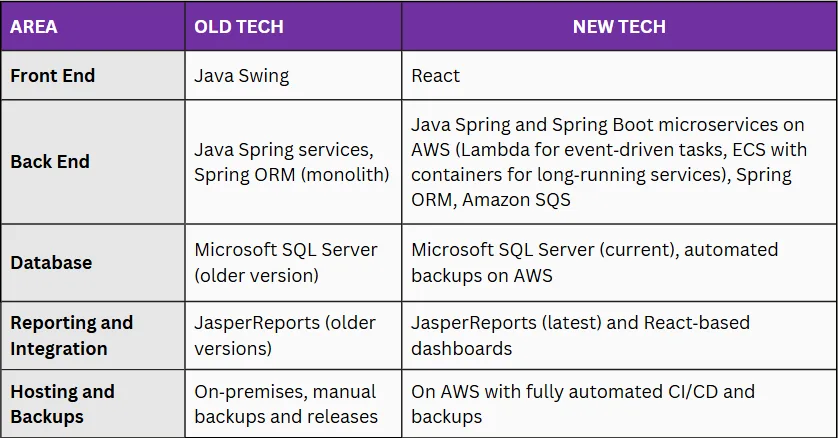
Using Arrk’s Remarrk™ Application Modernisation Framework, we produced a practical roadmap focused on scalability, reliability, security and cost control. The plan moved the client away from a monolith and manual processes to an automated, cloud‑based platform that can grow with the business.
Modernising Legacy Components
Migration Challenges and How We Addressed Them
Older Java Versions and Coding Styles
We used AI‑assisted tools to update the codebase to supported Java versions and modern language features. This sped up refactoring and reduced manual rework. We also used AI to generate and update unit tests to improve coverage.
Monolith to Microservices
The legacy application was a monolith. Using domain‑driven design, we split the system into microservices, each aligned to a specific business area. This improved change isolation and made enhancements easier. AI‑assisted design reviews helped test service boundaries early.
Manual Deployments
We implemented an automated pipeline so builds, tests, security checks and deployments run consistently. This removed bottlenecks and reduced release risk.
Parallel Run & Cutover
Data discrepancies during like‑for‑like testing
Differences appeared during parallel runs due to inconsistent databases. We created a fresh copy of the live database and used it as the single comparison source for side‑by‑side validation.
Daily snapshots and a clean cutover
While both systems ran in parallel, we took a daily snapshot from the live database and loaded it into the new system for test runs. On the planned cutover date, we made the old system unavailable and directed all users to the new platform. Any issues were fixed forward in the new system rather than rolling back.
EmbArrk workshop
Efficient and Faster
Process Automation
Solution
Architecture: Event‑driven and container‑based microservices
- Compute and integration: AWS Lambda, AWS ECS (containers), API Gateway
- Messaging and events: Amazon SQS, Amazon EventBridge
- Storage and delivery: Amazon S3, Amazon CloudFront
- Communications: Amazon SES
Application layers
- Front end: React for a clearer, faster user experience
- Back end: Refactored Java codebase using Spring and Spring Boot to integrate with AWS services
Engineering practices
- AI‑assisted coding and testing to accelerate refactoring and improve coverage
- CI/CD for automated builds, tests, security checks and deployments
- Automated backups for SQL Server on AWS
The result is a stable, scalable system aligned with business logic and ready for future change.
EmbArrk workshop
Efficient and Faster
Process Automation
Outcomes
To address concerns about cloud cost and security, Arrk provided its Commercial Support Flex Model. The service includes:
- Lower monthly cloud infrastructure costs through right‑sizing and automation
- High availability and predictable stability
- End‑to‑end information security managed by a single team
- Stabilised operations during an incident, followed by a planned modernisation
- Reduced operational risk by replacing end‑of‑life components and removing key‑person dependencies
- Faster change cycles with automated pipelines and microservices
- Lower running costs and an improved security posture on AWS